
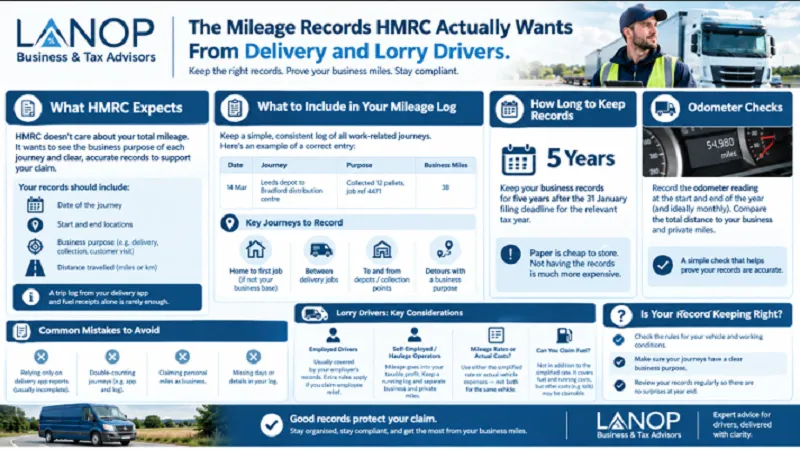
Most of us know roughly how many miles we’ve driven last year. Fewer of us have the proof ready on demand, which is why an accountant for lorry drivers is such a valuable ally. HMRC is not concerned with your overall mileage. Its priority is to establish the proportion of the driving that was for a business purpose, and if your mileage records back your claim. A trip log from the delivery app and a stack of fuel receipts might seem like proof, but rarely hold up.
What Should Mileage Records Show?
Whatever claim you make to HMRC must have the supporting evidence. If questions arise, you will have to provide the information that will show where you went, what you did and how much of the mileage was for a business purpose. There is no prescribed format for creating such records, but there is one simple test HMRC will apply.
What to include in a mileage log?
Think of the log as a diary of all your working days. Make sure that every journey has a date, the place where it started and finished and a brief reason. Here is an example of a correct entry:
14 March | Leeds depot to Bradford distribution centre | Collected 12 pallets, job ref 4471 | 38 business miles
Anyone reading this should not have any doubt about what this part of the day was for.
How long do I need to keep the records?
As a self-employed driver, you are expected to keep any business records for five years after the 31 January filing deadline for that tax year. Employees claiming relief should check the requirements for their claim. Paper is cheap to store, but failure to produce required information during acquisition is much more expensive.
Keeping a Log Without Losing Your Mind
Ravi drives five shifts a week, usually around north Leeds. For years he relied on a summary of his January driving provided by the app, until HMRC questioned him about a gap that the record didn’t cover. Ravi changed his habits and now keeps a daily log of all his work-related journeys.
What to record in a shift?
Start the log at the beginning of your shift and finish at the end. Include the drive from your home or base to the first job, all the journeys in between and the drive back. If you had to make a detour, make a note of it even if it wasn’t long enough to be worth claiming.
App, spreadsheet or notebook?
The choice of method is not important, as long as you are consistent. A GPS app is a good way to capture the travel that otherwise may not be recorded. A spreadsheet allows you to total the distances quickly, while a log kept in a notebook in the cab is easier to update. Inconsistency is more likely to occur if you change your method during a tax year.
Checking against the odometer
The odometer is your best independent check of the mileage records. Record the figure at the start and the end of the year, and preferably at the end of each month. Compare the total distance to all your business and private or commuting miles.
Ravi’s car had an odometer reading of 54,200 in April and 54,980 the following year, so he drove 780 miles in that year. His mileage log shows that he drove 610 business and 170 private or commuting miles; the figures are a good match and his records can support the claim. He can explain that 780 miles account for the car’s movement and he has used the log to separate business from private or commuting mileage.
Can I rely on the delivery app’s report?
The apps are made for making it easier for the platform: the majority start recording the journey once you accept the job. That means that the drive to the first delivery point, positioning trips and the journey back after the last drop-off may not be captured.
What about mileage between jobs?
Some of these journeys are allowable, some aren’t. The movement between jobs can be expected to have a business purpose, whereas a drive from one’s home or base to the first jobs may not, unless the home is the actual base of operations. Think about the reason why the vehicle was on the road.
What if they don’t match?
Put the two sets of figures against each other; check if there are days when the app records a trip for work, but the log is silent, and vice versa. Double-counting is a common pitfall. If one app covers journeys that another doesn’t, the same trip can be recorded twice.
Which journeys qualify for business mileage?
The one rule that explains most of the cases is that the journey needs to have a business purpose. The distance on its own can tell HMRC little about why the vehicle was on the road.
Between jobs
Journeys between delivery jobs are the clearest example of a trip that should be claimed. So are the movements to depots to collect new orders. Heading to an area where the job is expected to be located is generally considered to have a business reason, though it’s wise to note it.
Home to first area
This includes many people, from those making a commute to their regular job to the shift drivers whose first jobs are local to their home. The only exception is home base where the home is a permanent fixture of the business: some home-based operators have a specific room fitted out as an office.
Personal detours and trips
The drive home may be split between the delivery and personal errands, claiming the former only. The trip to the supermarket can be claimed if the journey was necessary to get there: detours to deliver parcels to friends don’t suddenly transform the private errand into a delivery.
Lorry Drivers: What Rules Apply?
Driving a lorry instead of a van or a car makes a difference. Your working conditions dictate which rules you are expected to follow.
Employed lorry drivers
If you are being paid for the business journeys, the records of your employer will reflect that. If you are claiming employee relief on the travel your employer doesn’t reimburse, there are more restrictions and the location of your workplace is relevant.
Self-employed drivers and haulage operators
The mileage goes directly into your taxable profit, so the correct records are important. A running log, a sensible vehicle-costing system and a clear allocation between business and private journeys will get you far.
Do simplified rates apply to every lorry?
They were designed for cars, vans and motorcycles, and the majority of heavy goods vehicles are in a separate category. Make sure your vehicle has the flat rate mileage allowance before claiming it on an HGV.
Mileage Rates or Actual Vehicle Costs?
You can take the simplified mileage rate for every business mile, or subtract the business portion of your actual running costs. Either approach will work, but you can’t mix the two for the same vehicle.
Can I claim fuel?
Not in addition to the simplified rate for the same vehicle. The figure covers the cost of fuel, but other expenses like road pricing and tolls may be reclaimable separately, so check before claiming.
When to Call an Accountant for Lorry Drivers?
Seek professional assistance if your mileage records are sparse, you are unsure if the journeys qualify or you can’t decide between a simplified mileage rate and actual vehicle expenses. It’s also a good time to talk to an accountant if you have more than one vehicle, work as a multi-platform driver or are unsure if your income is employed, self-employed or company income.
A good accountant for lorry drivers will look past the figures and ask about your working conditions and what your records actually say. They will advise you on the most advantageous method for your particular case.
Frequently Asked Questions
What mileage records does HMRC require from delivery drivers?
HMRC doesn’t specify a particular format, but expects a record to include the date, the journey, the business purpose, and the distance. Requirements depend on whether you are claiming as an employee or as self-employed.
Is my delivery app’s mileage report sufficient?
It is a useful piece of evidence, but rarely constitutes a complete picture. The drive to your first job, positioning trips and the journey back after your last drop-off often fall outside it, so keep your own mileage records.
Can I claim the miles driven between delivery jobs?
Usually, yes, as long as the journey has a genuine reason. Make a note in the log every time you make one.
Can I claim mileage and fuel costs together?
Generally not for the same vehicle. The simplified mileage rate covers all running costs so you choose either it or your actual vehicle expenses.
Conclusion
The best mileage records are the ones that you keep up to date. Log your business journeys, retain the information that can support your claim and separate business from private or commuting mileage. Check the rules for your working conditions and what vehicle you are using before claiming, and review your records every month so the year-end return doesn’t come as a surprise. If your records do not look convincing, Lanop Business & Tax Advisors can help you bring them up to standard.